All employees, contractors and visitors working on or near mobile and fixed equipment at the mine site, surface and underground
Owner
Maintenance Superintendent
Approver
Mine Manager and Site Safety Manager
1. Purpose
To stop the uncontrolled release of energy while people are inspecting, cleaning, repairing, adjusting or unblocking equipment. Every year, miners are crushed, caught, burned or electrocuted because a machine started, moved or released stored energy while someone was working on it. This procedure removes that risk by isolating every energy source, locking it off, proving it is dead, and returning it to service in a controlled way.
2. Scope
This SOP applies to all work where unexpected start-up, movement or release of stored energy could injure a person, including:
Haul trucks, loaders, dozers, graders, drill rigs, shovels and excavators
Crushers, screens, conveyors, feeders, mills, pumps and fans
Electrical switchgear, transformers, motor control centers and cables
Hydraulic, pneumatic, fuel, water and process piping systems
Any equipment with suspended, pressurized, spring-loaded or gravity-fed parts
Not covered: hot work, confined space entry and work at height each have their own permit and SOP. They are used together with this procedure, never instead of it.
3. Definitions
Term
Meaning
Isolation point
A device that physically blocks an energy source: breaker, disconnect, valve, blind flange, battery isolator, wheel chock or block.
Lock (LOTO)
A personal, keyed safety lock. One lock, one key, one person.
Tag
A tag fixed to the lock showing the name, crew, date and reason. A tag alone never isolates anything.
Authorized person
A trained and assessed worker who may apply locks and perform isolations.
Affected person
Anyone who operates or works near the equipment but does not lock it.
Isolation Controller
The authorized person in charge of the isolation for the job (usually the maintenance supervisor or leading hand).
Group lock box
A box holding the keys of the primary locks, secured by each worker's personal lock.
Zero energy state
Every energy source is isolated, released or restrained, and this has been proven by test.
Try-out
Attempting to start the equipment from its normal controls to prove the isolation works.
4. Roles and responsibilities
Role
Responsibilities
Mine Manager
Provides resources, enforces the SOP, reviews every isolation incident.
Maintenance Superintendent
Owns this SOP, keeps the equipment isolation register current, audits compliance monthly.
Supervisor / Isolation Controller
Plans the isolation, checks the permit, holds the group lock box, signs off start-up.
Authorized person
Applies and removes isolations, performs the try-out, completes the permit.
Every worker
Applies a personal lock, checks the isolation before starting work, stops the job if anything changes.
Operators
Never start or move a machine with a lock or tag on it. Report anything unusual.
Contractors
Follow this SOP. Use their own locks and tags, and report to the Isolation Controller before starting.
5. Equipment and materials
Personal safety padlock (red, individually keyed) with a name tag for every worker
Danger tags, including "DO NOT OPERATE" and "OUT OF SERVICE"
Group lock boxes and lock hasps (multi-lock devices)
Valve, breaker, plug and battery isolator lockout devices; wheel chocks and blocking
Voltage tester (rated for the system, proved on a known live source before and after use), pressure gauge, insulated gloves, arc-rated clothing where required
Isolation permit forms and equipment isolation procedures (energy source maps) for each major machine
Standard PPE: hard hat, safety glasses, hi-vis, gloves, safety boots, hearing protection
5A. Site-specific parameters
Parameter
Value at Ridgeline Copper Mine
Personal lock
Red padlock, individually keyed, name tag with photo; issued by the maintenance planner
Group lock box
Yellow box at each isolation point; the Isolation Controller holds the primary key
Danger tags
Red DO NOT OPERATE tag with name, crew, date and time
Permit form
HSE-F-014, kept with the job and filed for 3 years
Voltage rating
Test 480 V, 4.16 kV and 13.8 kV systems with a rated tester; high-voltage isolation only by authorized electricians
Typical systems
Cat 793F battery isolators, PC5500 hydraulic accumulators, concentrator conveyors C1 to C6, SAG and ball mill drives
Isolation register
Kept in the CMMS; every machine has an energy source map at its isolation point
Radio
Ch 2 for maintenance isolations; tell the control room on Ch 1 before isolating plant
6. Golden rules
Your lock, your key, your life. Never lend a lock or a key. Never remove another person's lock.
Every person, every lock. Each person working on the equipment applies their own lock. No lock on the box, no work.
Isolate, lock, test, then work. A switched-off machine is not an isolated machine.
Prove it dead. Always do the try-out, and always test for no voltage.
Stored energy kills. Release, drain, block or restrain it before you touch anything.
If the job changes, stop. Re-assess before continuing. A new task needs a new check.
When in doubt, stop and ask. You will never be disciplined for stopping a job on safety grounds.
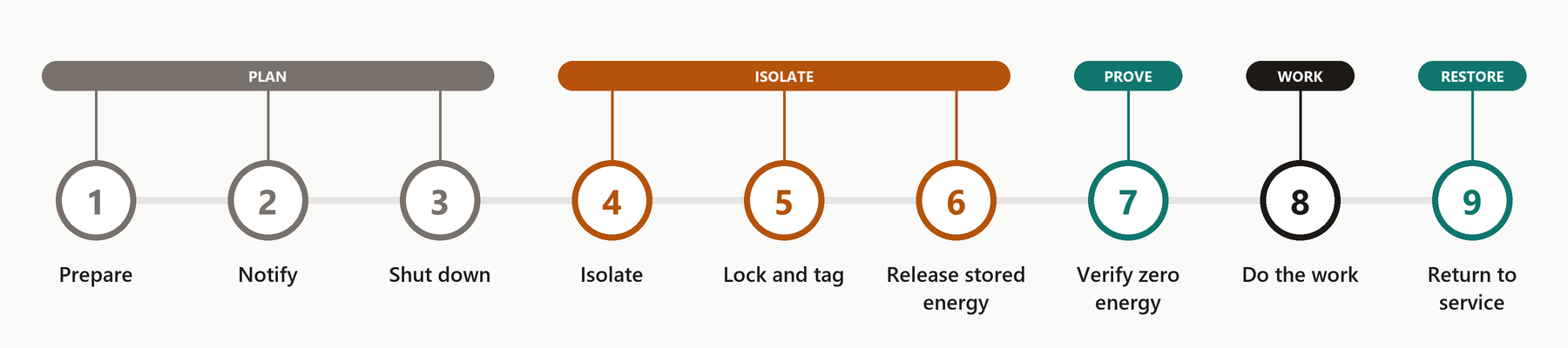
Figure 1. The nine LOTO steps, grouped into plan, isolate, prove, work and restore.
7. Procedure
7.1 Prepare
Identify the equipment and read its isolation procedure and energy source map. If none exists, stop and ask the supervisor to have one written before work starts.
Complete the job hazard assessment (JHA). List every energy source: electrical, hydraulic, pneumatic, mechanical (springs, flywheels, rotating parts), gravity (raised booms, buckets, dump bodies, suspended loads), thermal, chemical, fuel and process material.
Raise the isolation permit. State the equipment, location, work to be done, isolation points and the names of everyone involved.
Check that everyone on the job is trained and has their own lock, tag and key.
Brief the crew. Make sure everyone understands the scope, the isolation points and what to do if something changes.
7.2 Notify
Tell the operator, the control room and every affected person that the equipment is about to be isolated, for how long and why.
Barricade the area and place warning signs at all access points. For mobile equipment, park on level ground, away from traffic and from any overhead hazard.
7.3 Shut down
Stop the equipment using its normal stopping procedure. Do not use an isolator to stop a running machine under load.
For mobile equipment: apply the park brake, lower all attachments (bucket, blade, dump body) to the ground, shut the engine off and remove the key. Chock the wheels.
7.4 Isolate
Operate each isolation point listed on the permit, in the order set by the equipment isolation procedure.
Electrical: open the breaker or disconnect and rack out where possible. Isolate batteries and any secondary or remote power sources, including control circuits and backfeed from generators.
Hydraulic and pneumatic: close the isolation valves and bleed the system.
Fluids, fuel and process material: close valves, fit blanks or blind flanges and drain the line where required.
Mechanical: lock the rotation, pin the articulation, block the dump body and boom, fit the safety props. Gravity is always on, so never trust a hydraulic cylinder to hold a load.
7.5 Lock and tag
The authorized person fits a lock and tag to each isolation point.
Where more than one person is working, the authorized person puts the keys into a group lock box. Every worker then fits their personal lock to the box.
Write on every tag: name, crew, date, time and reason. Tags must never be removed or altered by anyone else.
7.6 Release stored energy
Bleed hydraulic and pneumatic pressure to zero and confirm on the gauge.
Discharge capacitors and earth electrical conductors where the procedure calls for it.
Block or lower anything that could fall or swing: booms, buckets, dump bodies, hoppers, counterweights.
Release spring tension, secure rotating parts that could coast, and let hot surfaces and fluids cool.
Vent or purge residual fuel, gas, pressure and process material from pipes and vessels.
7.7 Verify zero energy
Try-out: attempt to start the equipment from the normal controls and from any remote or automatic controls. It must not start. Return all controls to the off position.
Electrical: test for no voltage with the approved tester. Prove the tester on a known live source before and after the test ("live, dead, live").
Pressure: confirm zero on the gauge, then crack a fitting slowly if the procedure allows, with the body clear of the discharge line.
The Isolation Controller confirms zero energy state and signs the permit. Only now may work begin.
7.8 Do the work
Stay within the scope of the permit. If the task changes, stop, make safe, and re-assess.
If a worker leaves the job, they remove their own lock from the group lock box at the end of their shift or when they leave. The equipment stays isolated while any lock remains.
If the job spans a shift change, the outgoing worker hands over in person at the equipment, and the incoming worker applies their own lock before the outgoing worker removes theirs.
7.9 Return to service
Remove tools, materials and rubbish. Refit all guards, covers and safety devices. Check no one is inside or on the equipment.
Every worker confirms their work is complete and that they are clear.
The Isolation Controller walks the area, then notifies operators and affected persons that the equipment is about to be re-energized.
Each worker removes their own lock. The authorized person removes the primary locks and tags, and restores the isolation points in the reverse order of the shutdown.
Re-energize, test run and watch the equipment for abnormal behavior. Close and sign the permit, then update the maintenance record.
8. Emergency and exception handling
8.1 Lock removal without the owner (last resort)
If a worker has left site with their lock still fitted, never cut it off on your own. The Supervisor and the Maintenance Superintendent must do all of the following:
Make every reasonable attempt to contact the lock owner, and record each attempt.
Check that the lock owner is off site and that the work is safe to return to service.
Obtain written approval from the Mine Manager or Site Safety Manager.
Remove the lock with approved cutters, and record the removal.
Tell the lock owner before they next start work, and file an incident report.
8.2 Emergency
If anyone is injured or trapped, press the emergency stop, call the emergency number or radio channel, and start first aid. Do not remove locks to re-energize equipment unless the Incident Controller orders it and the risk is understood.
Report every unexpected movement, start-up, release of energy or failed isolation immediately. This is a high-potential incident: stop all work on the equipment and quarantine it for investigation.
9. Training and competency
Group
Training required
Refresher
All workers and visitors
Induction on the golden rules and what a lock and tag mean
Yearly
Authorized persons
Full LOTO course, practical assessment on each equipment type, and sign-off by the Maintenance Superintendent
Every 2 years, and after any incident or procedure change
Isolation Controllers
Authorized person training plus permit and group lock box management
Every 2 years
Contractors
Site induction and proof of equivalent training before starting work
Each engagement
10. Records and audits
Keep all isolation permits for at least 3 years, or longer where local regulation requires.
The Supervisor audits at least 5 live isolations per month. The Maintenance Superintendent reviews the results and reports to the safety committee.
Every procedure is reviewed after an incident or near miss and at least every 12 months.
Key measures: percentage of jobs with a completed permit (target 100%), audit non-conformances closed within 7 days, number of isolation failures (target zero).
11. Quick reference
Step
Action
Done when
1
Prepare: JHA, energy sources, permit
Permit raised and crew briefed
2
Notify: operator, control room, affected people
Everyone knows, area barricaded
3
Shut down normally
Equipment stopped, attachments down, key out
4
Isolate every energy source
All points operated in order
5
Lock and tag
Every worker's lock on the box
6
Release stored energy
Pressure bled, loads blocked, parts cooled
7
Verify: try-out and voltage test
Zero energy confirmed and permit signed
8
Work within the permit scope
Job complete
9
Return to service in a controlled way
Locks off, permit closed, test run done
12. Related documents
Confined space entry SOP, hot work permit SOP, work at height SOP
Equipment isolation procedures and energy source maps (one per machine)
Job hazard assessment template and incident reporting procedure
Applicable regulations for your jurisdiction, for example MSHA 30 CFR Parts 56 and 57 in the United States
Controlled document. The current version lives in this library. Printed copies are uncontrolled: check the revision before you use one. Questions or improvements go to the document owner.
 Ridgeline
/
Ridgeline SOP Library